By Riddhesh Patil7 min read
SEO, GEO and AEO are one problem
Your next customer might never see your homepage. They ask ChatGPT for "the best payroll tool for a 40-person startup", read a paragraph that names three companies, and click one. If you're not in that paragraph, you weren't in the running.
That shift has produced a pile of acronyms. SEO, GEO and AEO get sold as three separate disciplines, often by three separate agencies. They aren't separate. They're one question asked in three places: when someone looks for what you do, are you the answer?
We built Squawk to measure this for clients. What follows comes from those audits.
What the three words mean
| Where it happens | What winning looks like | |
|---|---|---|
| SEO, search engine optimisation | Google and Bing results pages | Your page ranks for the words buyers type |
| AEO, answer engine optimisation | Featured snippets, voice assistants, Google's AI Overviews | Your page is the one quoted as the answer |
| GEO, generative engine optimisation | ChatGPT, Perplexity, Gemini, Claude, Copilot | The AI names you, describes you correctly, and cites your site |
In practice people use AEO and GEO loosely, and they overlap. Don't lose sleep over the labels. The useful part is the last column: three ways of being found, all of which now matter.
Four myths worth ignoring
"SEO is dead." It's the opposite. Many AI answers are built on top of search results. Google's AI Overviews are written from Google's own index, and Copilot answers from Bing. When an assistant searches the web before it answers, the pages it finds are mostly the pages that already rank. A better ranking is often the first sign of a better AI result.
"GEO needs a whole new kind of content." Mostly it doesn't. The pages AI engines like to quote are the pages people like to read: they answer the question in the first paragraph, use real numbers, cite sources, and say who wrote them. Most of the fixes that move AI answers also move rankings.
"Add an llms.txt file and you're done." llms.txt is a proposed file that lists your key pages for language models. It's cheap to add and harmless, but no major engine has confirmed that it uses it. Treat it as tidying, not strategy.
"You can track your ranking in ChatGPT like a Google position." Ask ChatGPT the same question five times and you can get five different answers, naming different companies in a different order. A single screenshot proves nothing in either direction. More on measuring this properly below.
The checklist: what to do this week
These are the checks that most often fail when we audit a site, roughly in the order we'd fix them.
1. Let the AI crawlers in
Each engine has its own crawler, and some have two: one that builds an index and one that fetches pages live when a user asks. The ones worth checking in your robots.txt:
- OpenAI:
GPTBot,OAI-SearchBot,ChatGPT-User - Anthropic:
ClaudeBot,Claude-User - Perplexity:
PerplexityBot,Perplexity-User - Google:
Google-Extended, which governs Gemini's use of your content. It doesn't affect Google Search, and AI Overviews read your site through the normalGooglebot.
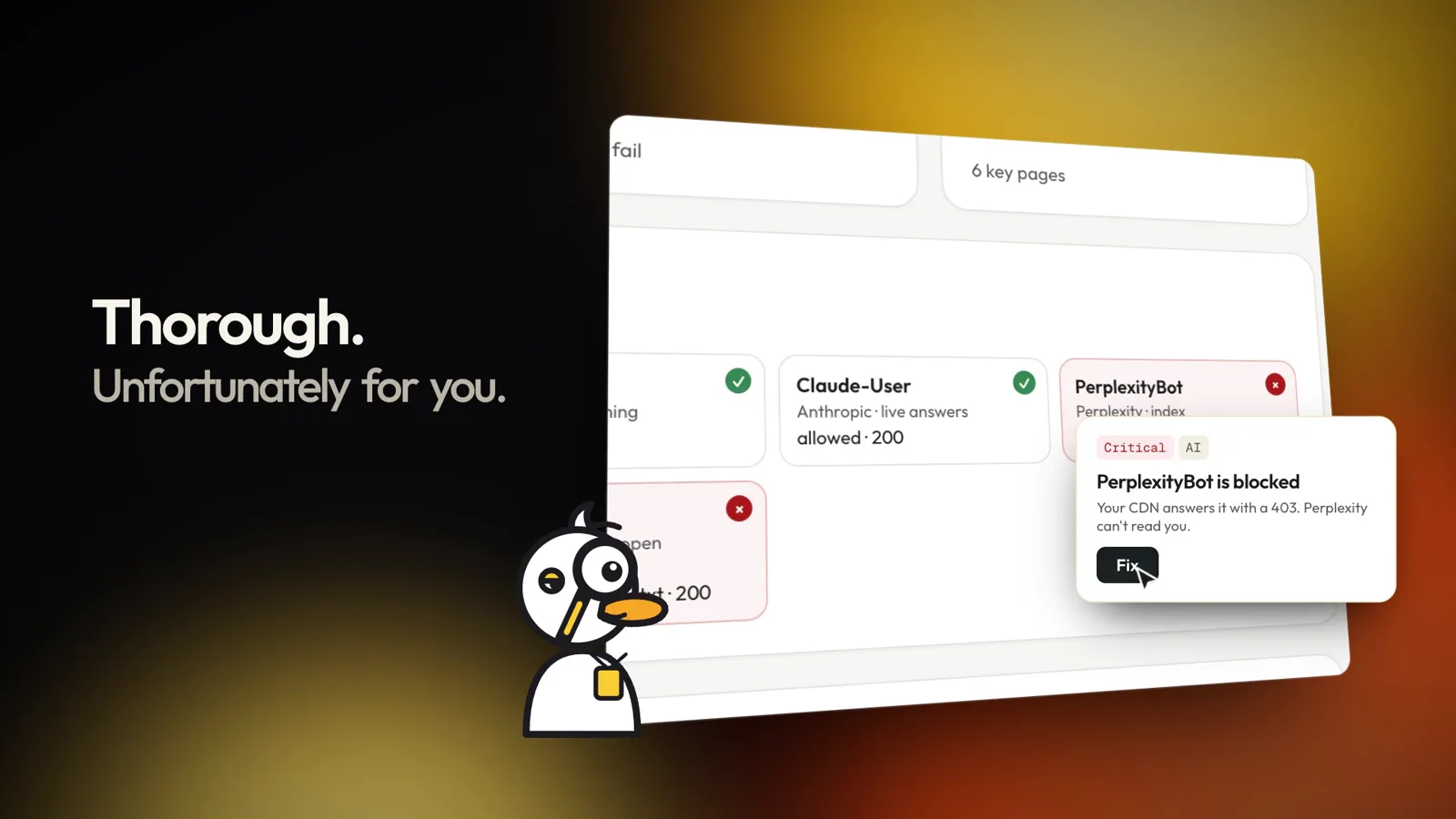
Then check that your site actually serves them. robots.txt can say yes while your CDN or firewall says no. Bot-protection rules increasingly block AI crawlers by default, and Cloudflare started doing that for new sites in 2025. Fetch a key page with each crawler's user agent and look at the status code. A 403 means that engine can't read you, whatever your robots.txt says.
2. Put the content in the HTML
Many crawlers don't run JavaScript, or run it badly. If your page's text only appears after a script loads, some engines see an empty page. View the page source (not the inspector) and check that your main content is there. Content hidden in tabs and accordions is also easy to miss, so keep the important bits visible.
3. Write answer-first pages
For each question a buyer might ask, there should be one page that answers it well. The patterns that get pages quoted:
- Answer first. A short opening paragraph, under about 60 words, that directly answers the question in the title.
- Facts and figures. Prices, timelines, numbers and named examples rather than adjectives.
- Sources. Link the studies, standards or official bodies behind your claims.
- Tables for anything comparable: plans, specs, options.
- A named author and a visible "last updated" date.
- An FAQ with matching
FAQPagestructured data, where it genuinely fits.
4. Make the web agree about who you are
When an AI engine describes your company, it leans on what the wider web says, not just your site. Three things help it get you right:
- A Wikidata entry for the company, with your official website on it.
sameAslinks in your site'sOrganizationstructured data, pointing at your real profiles: LinkedIn, Crunchbase, your business listing. Use the same set on every page.- Facts that match everywhere. Your name, founding year, location, services and contact details should be identical on your site, LinkedIn, your business listing and the main directories. Every mismatch is a chance for an engine to pick the wrong one.
A related problem is namesakes. If another company shares your name, AI answers can blend the two. Consistent entity data is your best defence.
5. See who gets cited instead of you
Ask the questions your buyers ask, and look at which sites the answers cite. Sort them roughly into competitors, editorial sites (press, industry publications), community sites (Reddit, forums), reference sites (Wikipedia, docs) and directories. This tells you what kind of work will help:
- Competitors' pages win: build or improve your own page on that topic.
- Editorial or community sources win: another page on your site won't help. You need to be mentioned there: coverage, guest pieces, honest answers in the threads people actually read.
How to tell whether any of it worked
This is where most "AI visibility" reporting falls apart. Answers vary from run to run, and the engines change their models whenever they like. Say a number goes from 20% to 28%: that might mean your work paid off, or it might mean nothing at all. A defensible method has five parts.
1. Use the questions buyers actually ask. Write 20 to 40 of them in your buyers' words, and split them by kind:
- Brand ("What does Acme do?") checks whether AI describes you correctly.
- Category ("Best payroll tool for a 40-person startup") is the one that wins new business.
- Comparison ("Acme vs Rival") shows how you're positioned.
- Control questions are on a topic you deliberately won't work on. They're your yardstick.
2. Ask each question several times on each engine. We use five samples per question per engine for a baseline, and run the baseline twice, about a week apart, before any work goes live. The two baselines show you how much the numbers move on their own.
3. Report every number with its noise band. Give each metric a 95% range, worked out by resampling the questions it's built from. For a single question the range is a Wilson score interval: 3 of 5 answers is 60%, anywhere from 23% to 88%. A change only counts if it's bigger than the range. If it isn't, say so plainly.
4. Subtract the control. If your category questions rise 12 points and the control questions, which you never touched, rise 5, the engines shifted under everyone. Your real improvement is 12 − 5 = 7 points. If the control moves beyond its own noise band, flag the period as "engines changed" and don't claim a win from it.
5. Freeze the method. Lock the questions, competitors, engines and model versions before you collect data. Compare only like with like. Change the method and you need a new baseline.
None of it is advanced statistics. It's what a before-and-after claim needs to hold up when someone checks it.
One score, because it's one problem
Once you measure all three together, the overlap becomes obvious. One crawl of your site serves the search audit and the AI audit. A deeper page, a named author or a fixed crawler rule moves rankings and AI answers at the same time. That's why Squawk folds them into a single score: how often you're named in AI answers, read alongside your search ranking and how readable your site is to AI, each with its noise band.
You don't need a platform to start, though. Run the checklist above, ask your buyers' questions five times each, write down what you see, and do it again in a month. You'll learn more from that than from any dashboard of single screenshots.
If you'd rather have it measured properly from day one, Squawk does exactly this, and the first check is free.